
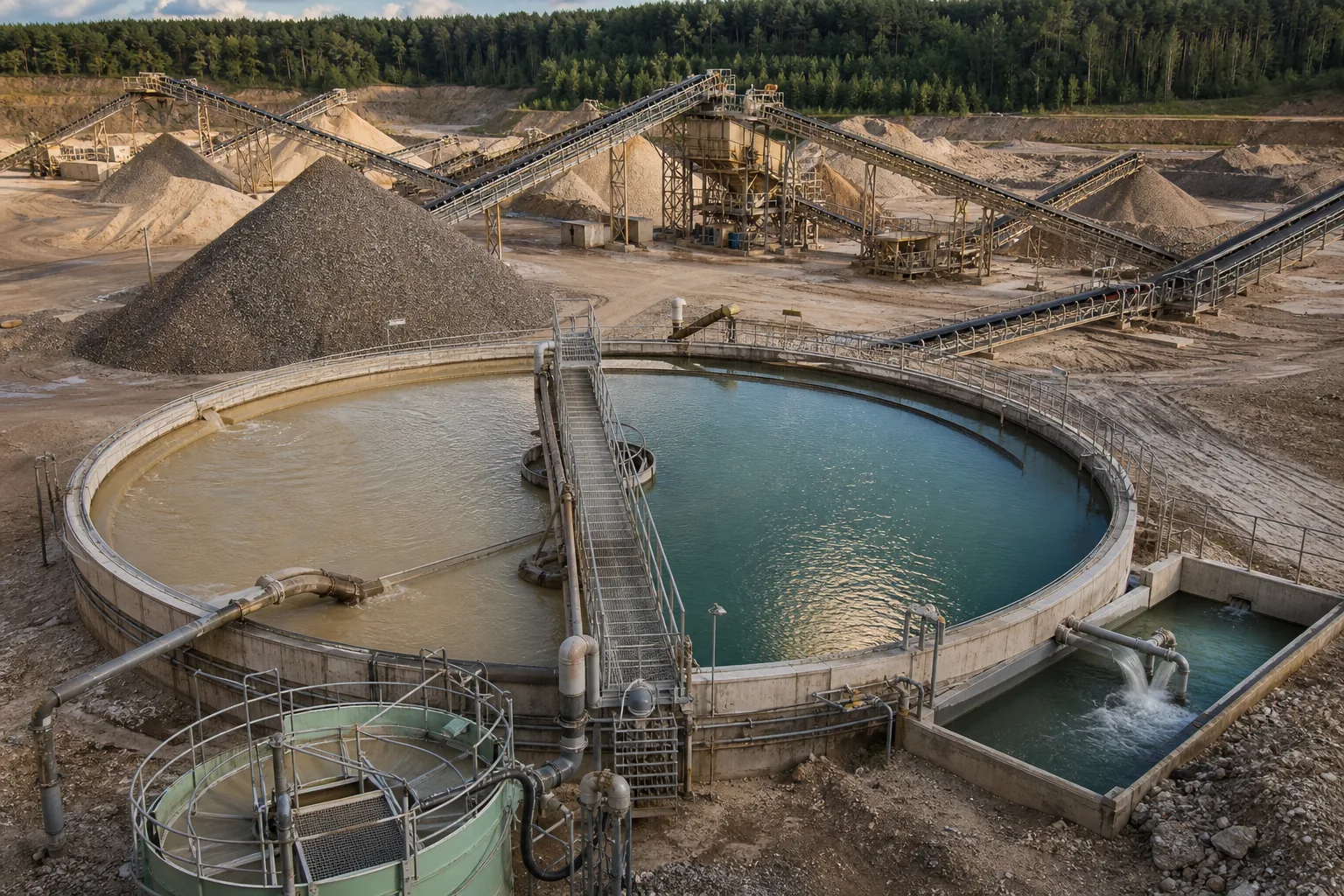
Define the purchase duty
Clay-rich wash water should be tested as the actual suspension the plant must separate. A candidate that works on a quieter low-fines sample may not cover the campaign that limits water recovery or overwhelms solids withdrawal.
Identify the sample, actual feed and required water-and-solids result before asking for a recurring supply commitment.
Capture the difficult fines condition
Record material source, fine-particle context, solids, pH, conductivity and upstream coagulant. Identify changes in recycle-water fraction and production loading. The wash-water application file provides the sampling boundary.
Do not collect only from a clear pond edge or dilute every sample with fresh laboratory water. Preserve the condition associated with the operational limitation.
Compare clarity and compactability
Prepare candidates consistently and bracket active dose. Measure overflow fines, interface movement and settled volume at fixed times. Include an incumbent and repeat the preferred point when sampling variation is significant.
The mineral test method supports the bench comparison without proving that a short jar reproduces thickener inventory or withdrawal behavior.
Approve reuse and solids removal
Set a water-quality endpoint appropriate to the washing circuit and a solids-handling requirement appropriate to the installed route. Review the actual injection, dilution and flow range during a plant trial.
Do not claim production or water savings from a single attractive sample. Measure whether the candidate maintains acceptable recycle and continuous solids removal at representative loading.
Test the limiting condition
A candidate can clear the water while creating a loose bed that reduces practical inventory margin. Keep that limitation beside the clarity result; a purchase should not move the problem from recycled water into unmanageable settled solids.
Preserve any untested condition in the acceptance record. A promising sample response is not an unrestricted capacity or treatment guarantee.
Keep a traceable comparison
| Purchase check | Evidence | Decision boundary |
|---|---|---|
| Feed | Representative clay-rich campaign | Limiting condition included |
| Bench | Rate, fines and bed volume | No clarity-only approval |
| Plant | Reuse and solids-removal outputs | Complete wash circuit duty |
Retain the commercial code, sample reference, preparation method and measurement timing. Record rejected conditions as well as the preferred point so later shipments can be assessed against the actual evidence.
Request a scoped recommendation
Send material and fines information, recycle-water data, separator and withdrawal arrangement, current dose and difficult-period measurements. Request a small justified grade set and a trial covering the limiting feed.
Use the anionic emulsion sample and quotation form and review supply and packaging controls with Gongyi Xinqi Polymer Co., Ltd.. Confirm offered grade, availability and commercial terms before ordering.