
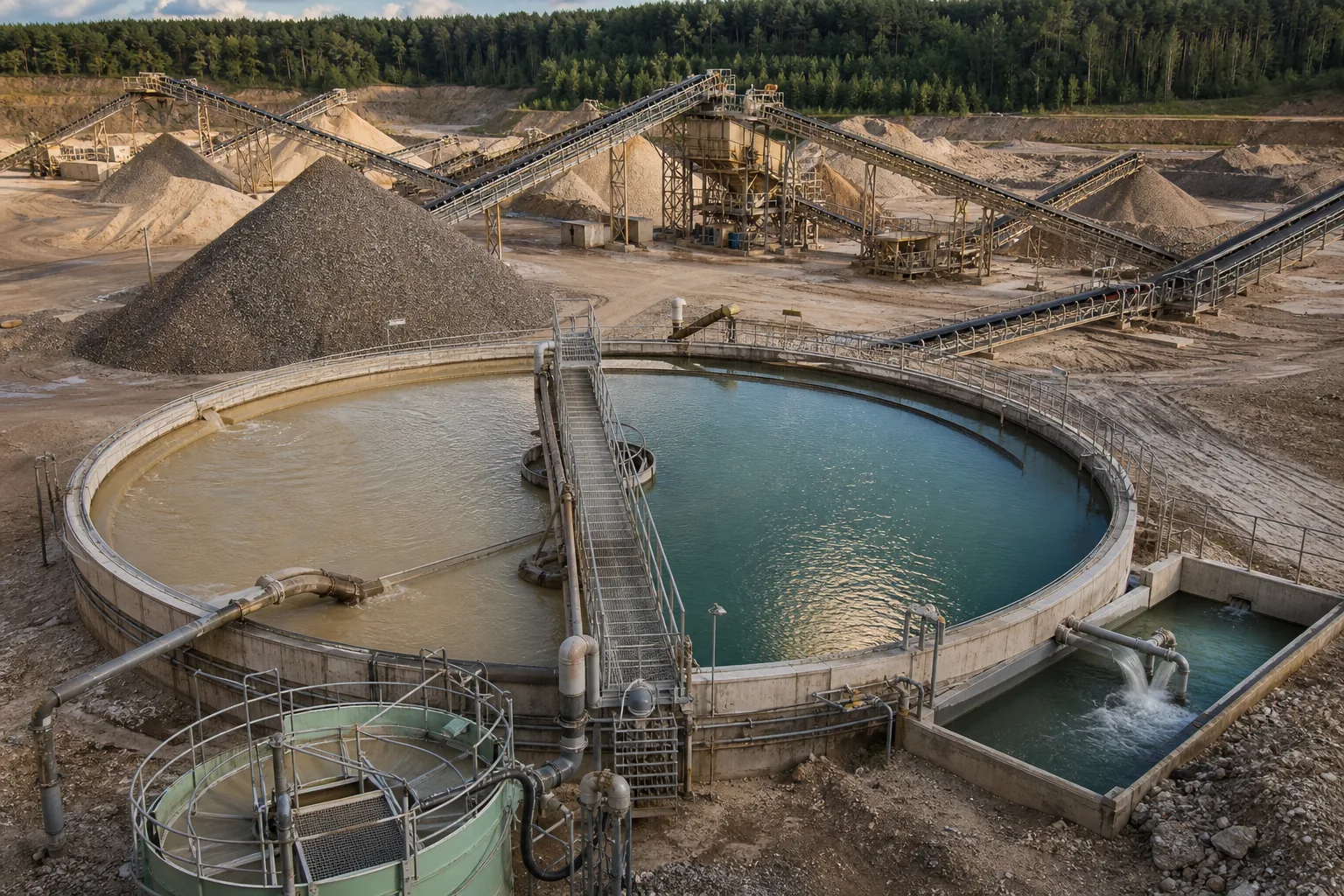
Describe the fines and recycle loop
Clay fraction, crushed-rock mineralogy, production rate and recycle-water chemistry can change rapidly. Record turbidity, solids, pH, conductivity and any coagulant before screening polymer.
Sample during representative washing rather than from a quiet pond edge. Keep difficult clay-rich campaigns visible in the trial set.
Control floc formation
Introduce activated emulsion where it can disperse across the stream without prolonged high shear. Compare floc growth, settling interface, overflow clarity and settled-sludge pumpability.
Overdose may create floating strings, unstable carryover or difficult sludge handling. Use small increments around the useful window and allow consistent observation time.
Confirm reuse and solids handling
Clarified-water quality must fit the wash circuit, while the settled solids must fit the thickener, pond, press or disposal method. Evaluate both sides of the separation.
Normalize cost to active polymer and dry solids, then relate it to recovered-water stability, production interruptions and solids removal rather than chemical price alone.