
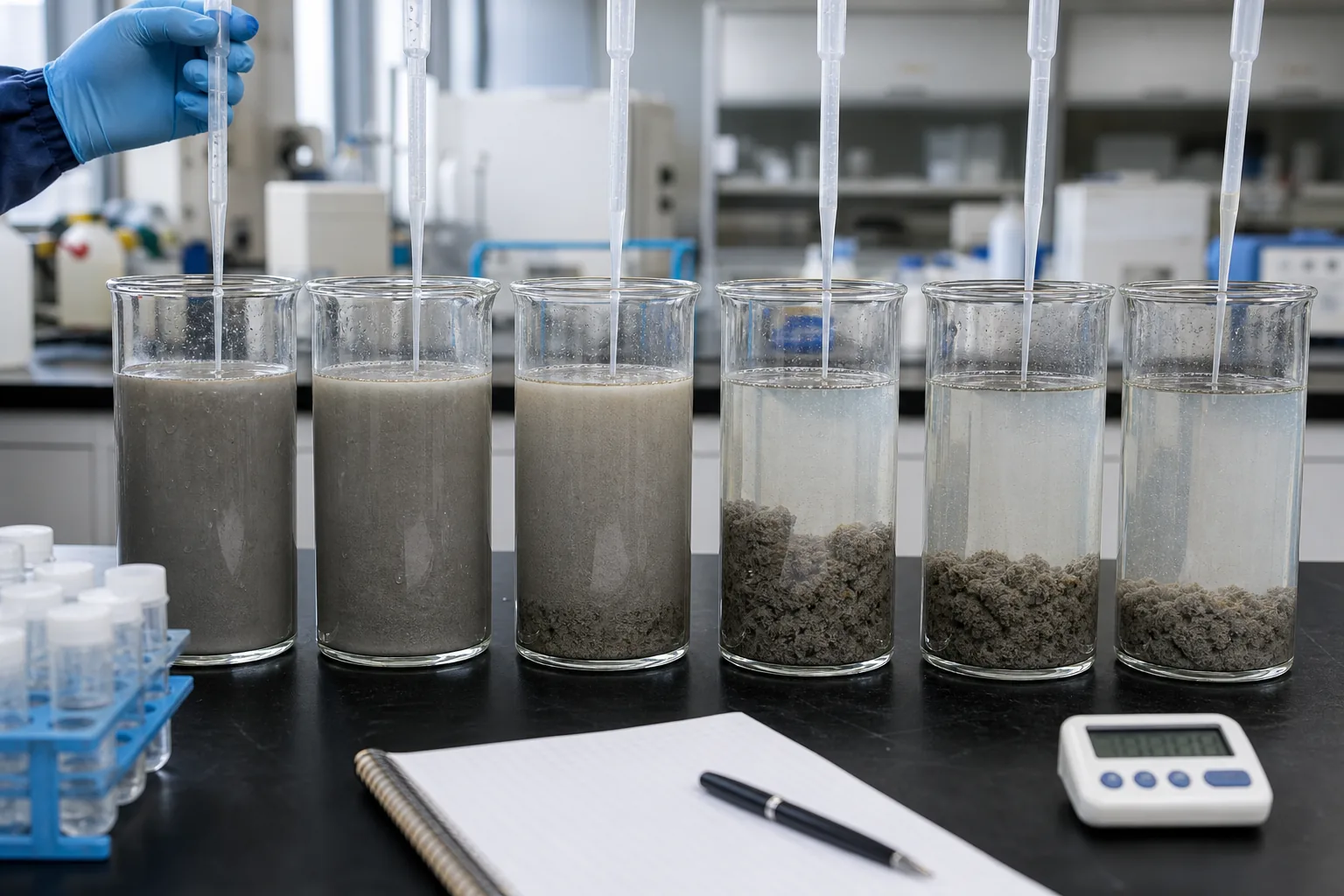
Collect representative feed
Sample across a stable operating period and preserve the solids-to-water relationship. Record ore source, grind, solids, pH, conductivity, temperature and upstream reagents.
If the process has distinct difficult campaigns, test them separately instead of making one average sample appear representative.
Prepare polymer consistently
Invert each emulsion using the same suitable water, contact method, concentration and aging time. Label sample code, lot and preparation time.
Discard a visibly failed preparation and investigate it. Do not use inconsistent solution quality as hidden variation in a grade comparison.
Calculate an active-dose ladder
Choose dose points that span underconditioned behavior, the likely operating window and a controlled overdose. Calculate on active polymer per dry solids.
Keep vessel volume and slurry solids consistent. Record every addition rather than reconstructing the curve later.
Standardize mixing
Use a repeatable rapid distribution step followed by gentler floc growth. Apply identical timing and geometry across candidates.
Observe floc formation during mixing, but do not change technique to help one beaker. The comparison depends on controlled energy.
Record settling behavior
Measure the interface at fixed times, overflow clarity or turbidity and the character of any suspended fines. Note floating floc, wall effects and uneven settling.
Use photographs as supporting records, not substitutes for measurements. A single final image cannot show interface speed or instability.
Assess compactability
Allow enough time to compare settled-bed volume and resistance to gentle disturbance. For thickener duties, assess whether the selected condition supports a manageable underflow.
Carry leading candidates into rheology, filtration or settling-column work when scale or residence time materially affects the decision.
Apply representative shear
Expose leading flocs to a controlled second mixing step or suitable pilot path that represents the plant. Measure whether fines return and whether floc rebuilds.
A grade that survives the relevant energy may outperform a larger but fragile initial floc.
Write the scale-up record
List feed data, solution recipe, active dose, observations, selected candidates and rejected conditions. State which plant measurements will confirm success.
Use the record to set initial pump and water flows, then verify them after several process residence times before adjusting.
Use blanks and repeat points
Include an untreated blank where the natural settling behavior is not already well characterized. Repeat the leading condition and one reference dose to reveal variation from sampling, preparation or timing.
A treatment improvement should be larger than the normal scatter of the method. Record disagreement between repeats rather than selecting only the favorable observation.
Preserve water chemistry
Use the intended make-down water and maintain slurry temperature and evaporation as consistently as practical. If recycle water is important, test a representative condition rather than substituting laboratory tap water without comment.
Measure pH and conductivity before and after any major conditioning step. Document coagulant or pH-adjustment sequence because changing order can create a different particle surface before polymer is added.
State uncertainty and limitations
Bench vessels cannot reproduce every feedwell, rake, pump or filtration effect. Identify the observations that are reliable at jar scale and those that require settling-column, pilot or plant confirmation.
Report the candidate range, not a universal dosage promise. The scale-up plan should include safe stop criteria, residence-time allowance and the plant measurements that will accept or reject the result.