
Define the purchase duty
A purchasing screen should explain why different anionic charge profiles are being compared. Neither a higher charge label nor a familiar mineral name proves the best grade. The useful sample set resolves an actual uncertainty about adsorption, fines retention or solids handling.
Identify the sample, actual feed and required water-and-solids result before asking for a recurring supply commitment.
Start from the unresolved plant result
Provide current grade, feed solids, particle-size context, pH, water chemistry and upstream reagents. State whether the limitation is dirty overflow, slow interface movement or difficult underflow. The charge-selection procedure organizes the screen without diagnosing the grade from one symptom.
Keep a representative incumbent comparison. If the feed changes between tests, the apparent difference may not belong to the candidate chemistry.
Ask for an interpretable bracket
Request identified adjacent profiles and the supplier reasoning for each. Keep active basis, molecular behavior and preparation requirements visible. Supplier charge categories may not be measured identically, so do not force unlike descriptions into a precise numerical ranking.
Use the low-charge profile and medium-charge profile as trial positions, not as guaranteed application classes.
Approve the combined endpoint
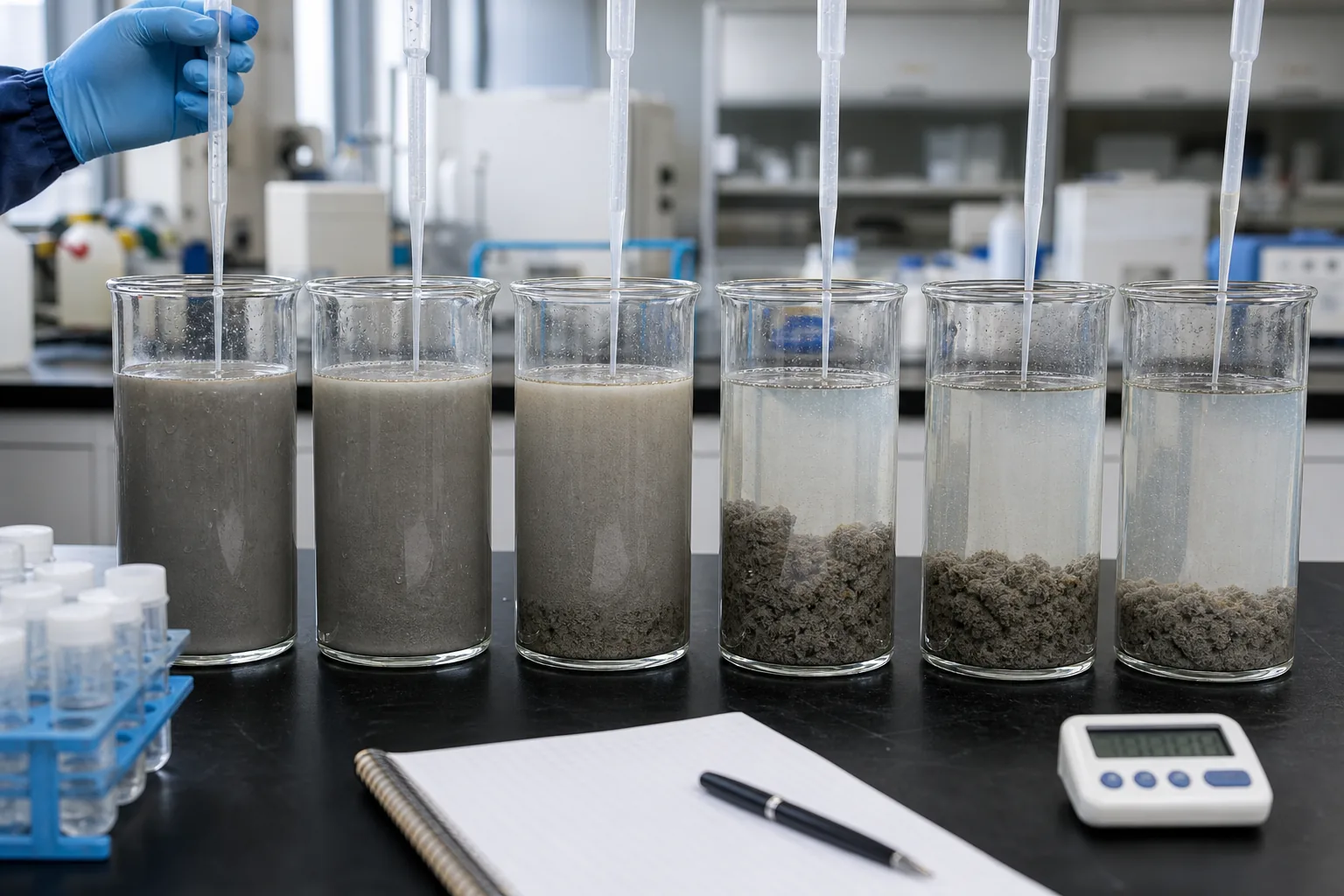
Run controlled dose curves with matched preparation and observation timing. Compare clarity, interface movement and compactability, then assess relevant shear and equipment response. Preserve useful and failed dose points so the practical window remains visible.
When two grades are close, review the range operators can maintain rather than awarding a single visually impressive beaker. A repeat comparison may be more defensible than a claim of exact superiority.
Test the limiting condition
A higher-charge candidate may settle the visible interface faster while leaving fines in the supernatant. Keep that split result in the offer comparison rather than calling the faster interface a complete product improvement.
Preserve any untested condition in the acceptance record. A promising sample response is not an unrestricted capacity or treatment guarantee.
Keep a traceable comparison
| Purchase check | Evidence | Decision boundary |
|---|---|---|
| Bracket | Candidate code and comparison purpose | Charge assumption is tested |
| Method | Active basis and matched timing | Like-for-like screen |
| Acceptance | Clarity, rate and compaction | Whole separation duty |
Retain the commercial code, sample reference, preparation method and measurement timing. Record rejected conditions as well as the preferred point so later shipments can be assessed against the actual evidence.
Request a scoped recommendation
Send feed and water data, incumbent code, current preparation and the unresolved endpoint. Ask for a small justified sample bracket and a production-code link for any candidate advanced toward an order.
Use the anionic emulsion sample and quotation form and review supply and packaging controls with Gongyi Xinqi Polymer Co., Ltd.. Confirm offered grade, availability and commercial terms before ordering.