
Use charge as a screening variable
Charge density changes the balance between polymer-solids interaction and repulsion, but it is not a universal ranking. Mineral surface chemistry, pH and multivalent ions can change adsorption.
Begin with a bracket rather than one assumed grade. Keep the molecular profile and preparation as comparable as practical while screening charge.
Describe the slurry
Record ore or solids source, particle-size distribution, solids concentration, pH, conductivity and relevant dissolved ions. Include recycle-water ratio and upstream reagents.
Test materially different campaigns separately. A blended sample can hide the fines or water condition that controls day-to-day performance.
Build a dose curve
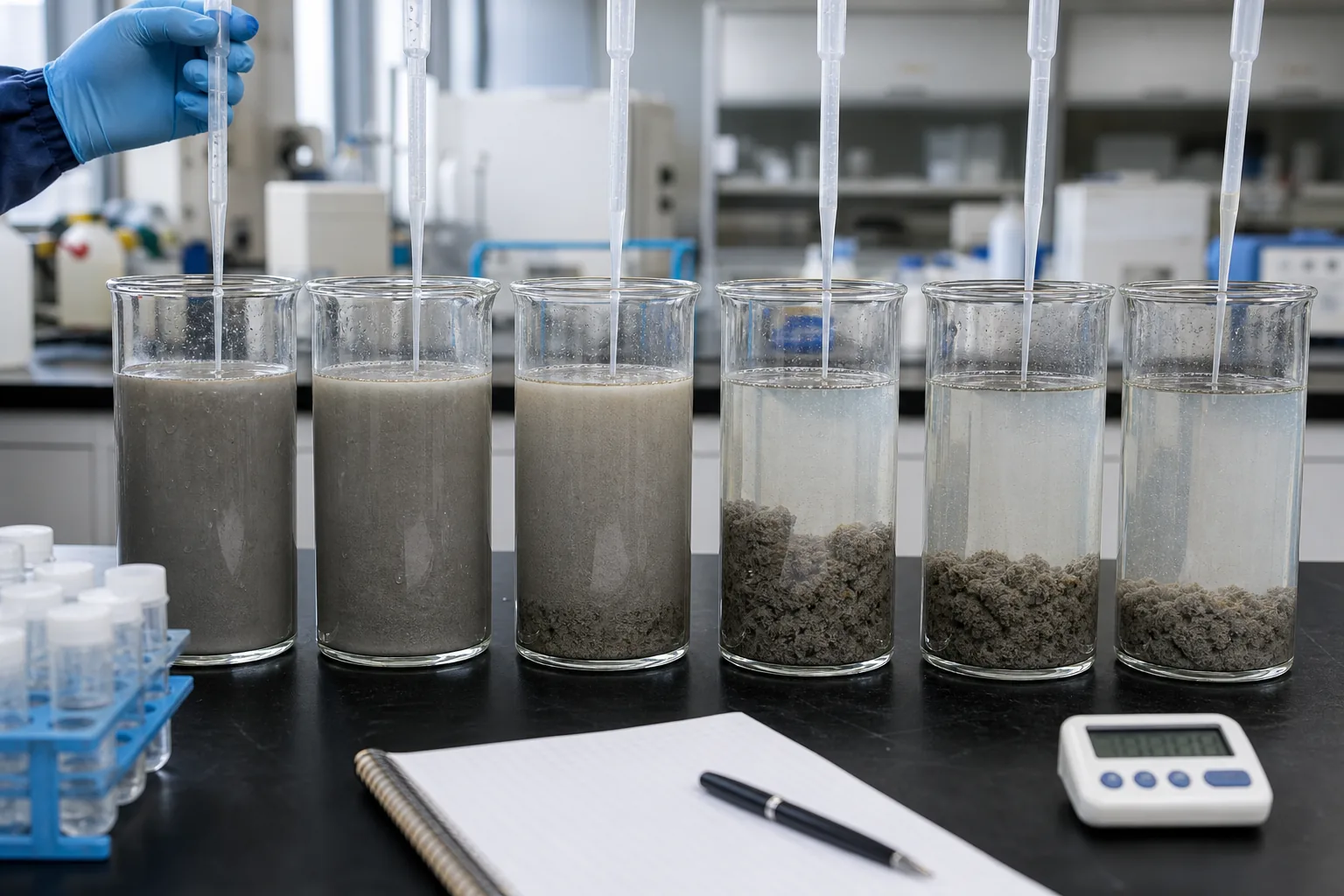
Use several active-dose points from underconditioned through the useful region and into clear overdose behavior. Apply the same mixing and observation times.
Record interface speed, overflow turbidity and settled volume. Avoid selecting from one visually attractive beaker.
Read underdose and overdose
Underdose may leave slow settling, diffuse floc and high overflow fines. Excess polymer may increase carryover, create rope-like aggregates or impair compaction and filtration.
The useful window is the lowest stable range that meets all relevant endpoints, not the dose that creates the largest floc.
Apply plant shear
Feed pumps, dilution water, feedwell geometry and transfer lines change floc formation. Reproduce representative energy after the initial bench screen.
If leading candidates reverse order after shear, carry that observation into injection-point and equipment decisions instead of treating it as laboratory noise.
Check downstream solids
Settling and clarity are incomplete when underflow must be pumped or filtered. Measure compactability, yield behavior, cake formation and filtrate quality where they affect operation.
A lower-charge grade may be preferable if it produces a denser, more manageable bed despite a slightly slower initial interface.
Write the selected window
Record product code, lot, active content, charge family, solution recipe, active dose, feed condition and equipment setting. State the variability tested and remaining uncertainty.
Use the record with the supplier RFQ checklist so repeat supply remains tied to demonstrated behavior.
Re-screen when the process changes
A major ore blend, pH control, coagulant, recycle-water or thickener change can move the charge optimum. Do not compensate indefinitely with dose alone.
Use routine trends to identify when the operation has left the approved window, then repeat a focused adjacent-grade screen.
Test the influence of dissolved ions
Calcium, magnesium, iron, aluminum and other multivalent species can change mineral-surface interactions and polymer conformation. Compare fresh and recycle-water conditions when their composition differs materially.
Do not use conductivity alone as a complete explanation. Record the known treatment chemicals and relevant ion data, then confirm the net effect through the same controlled charge and dose screen.
Use repeat tests and reference conditions
Repeat the leading dose on the same feed and include a consistent reference grade when practical. A single visual winner can reflect sampling, timing or mixing variation rather than a durable charge advantage.
Report the spread between repeats and any borderline endpoints. When two profiles perform similarly, prefer a pilot comparison or wider operating window instead of claiming precision the bench method cannot support.
Transfer charge language carefully
Supplier charge descriptions may use nominal categories, ranges or proprietary measures that are not directly interchangeable. Preserve the actual product codes and performance records when comparing offers.
Ask suppliers to propose adjacent candidates against the stated feed and endpoint rather than forcing unlike labels into a false numeric ranking. Final acceptance remains the representative process trial.