
Separate ionic type from delivery form
Anionic polyacrylamide describes a water-soluble polymer carrying negatively charged groups. Emulsion describes a concentrated inverse-emulsion delivery form in which hydrated polymer domains are dispersed before use.
Neither word defines the complete grade. Charge density, molecular architecture, active content and formulation can differ among products sold under the same family name.
Understand the working mechanism
The long polymer chain can adsorb on more than one particle and bridge them into larger aggregates. Ionic interactions, hydrogen bonding, mineral surface sites and dissolved ions all influence attachment.
Because mineralogy and water chemistry vary, the correct response must be demonstrated on representative slurry rather than inferred from a generic application list.
Activate before evaluating
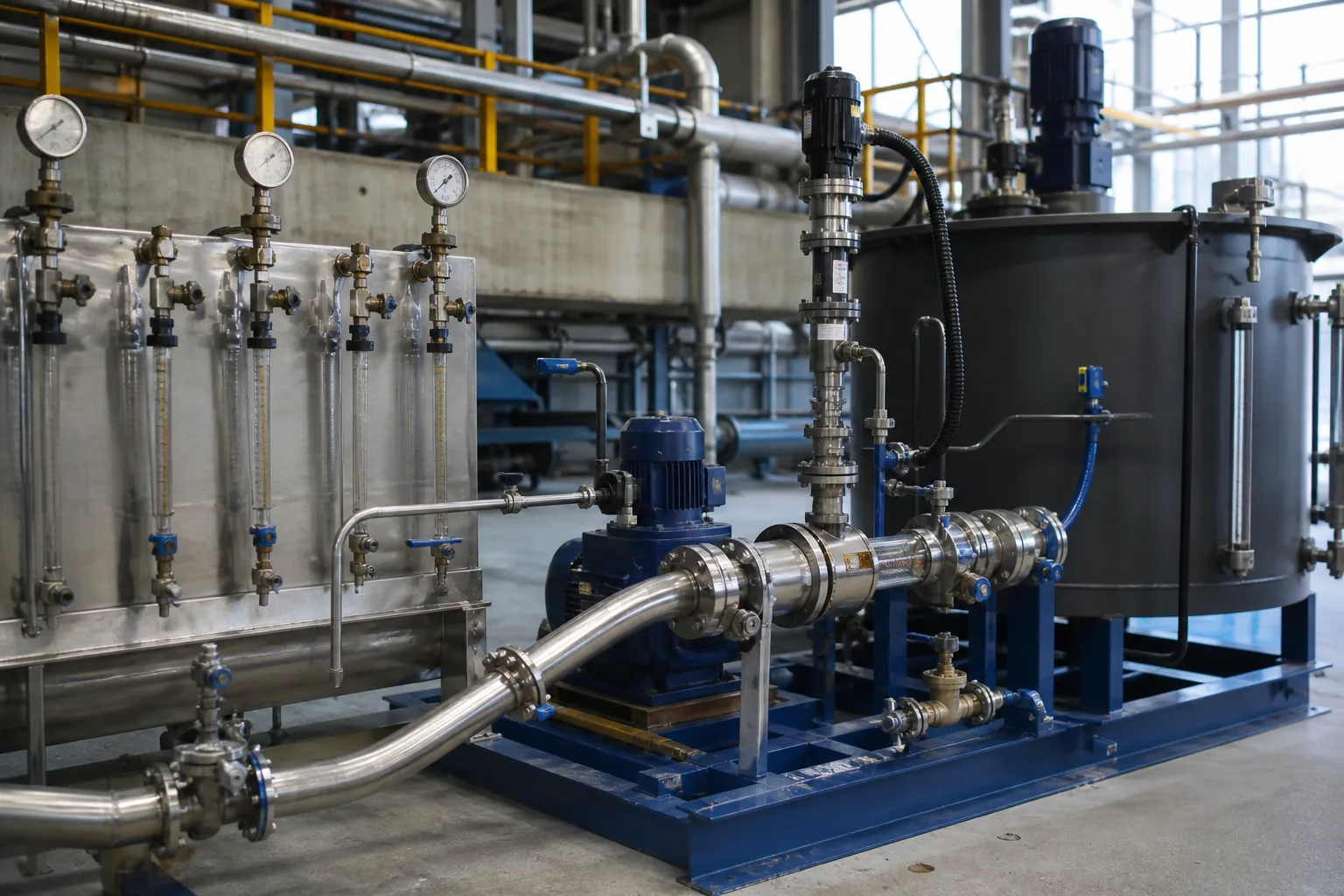
Inverse emulsion is not a ready-to-dose polymer solution. Water contact, initial dispersion, surfactant inversion, chain dissolution and aging must occur under controlled conditions.
Add emulsion into the water stream using appropriate contact shear, then protect the developed solution from unnecessary degradation. Record the method with every trial.
Match the separator endpoint
Jar tests reveal dose windows, settling and supernatant behavior. A thickener adds feedwell mixing, bed compaction and rake constraints; filtration adds cake formation, filtrate quality and release.
Advance a grade only after the full process endpoint supports it. Large flocs alone do not prove lower treatment cost or stable operation.
Normalize dose
Compare active polymer per dry tonne of solids. Neat-emulsion litres cannot be compared fairly when active content, density or slurry solids differ.
Calibrate pumps and confirm flow before scale-up. Keep the calculation with the trial record so purchasing and operations use the same basis.
Recognize unsuitable assumptions
Anionic charge is not automatically suitable for every suspension. Strongly negative organic solids or unusual upstream chemistry may need another ionic family, a coagulant step or a different sequence.
Environmental acceptability also depends on the complete formulation and intended discharge or solids destination. Review the current SDS and site requirements.
Build a traceable request
Send mineral or solids source, particle size, pH, conductivity, dissolved ions, upstream reagents, equipment and current performance. Add active dose and preparation details when a product is already used.
Include package, expected demand, destination and required documents. That record supports a focused sample set instead of a generic quotation.
Close the loop after delivery
Compare delivered product code, lot, seals, documentation and a retain sample with the approved trial material. Recheck the make-down recipe before diagnosing an apparent product change.
Monitor overflow, underflow, throughput and active dose after commissioning. Repeat the trial when ore, water balance or process chemistry moves beyond the approved window.
Control handling and housekeeping
Review the current SDS before unloading, transfer or make-down and use the supplier's product-specific requirements for protective equipment, spill response and waste handling. Prepared polymer solutions can create extremely slippery floors even when the spill appears small.
Provide containment, prompt cleanup, guarded transfer connections and a clear rinse procedure. Keep incompatible assumptions about powder handling out of the emulsion method because package opening, pumping and phase condition present different checks.
Distinguish chemistry from process variation
When performance moves, first compare feed solids, mineral source, water chemistry, upstream reagents and equipment settings with the approved window. Check neat and dilution flows before assigning the change to product quality.
Use a retained sample or controlled side-by-side preparation when evidence supports a product investigation. This prevents a seasonal ore or water change from being reported as an unexplained batch failure.
Verify the commercial grade
Connect the sample code to the production product code, active-content basis, package and agreed documents in the quotation. Confirm whether formulation, manufacturing location or grade identifier changes require notification and new review.
A useful specification protects demonstrated process behavior without inventing universal viscosity or molecular-weight limits. Receiving checks should confirm identity and integrity before the material enters the make-down system.