
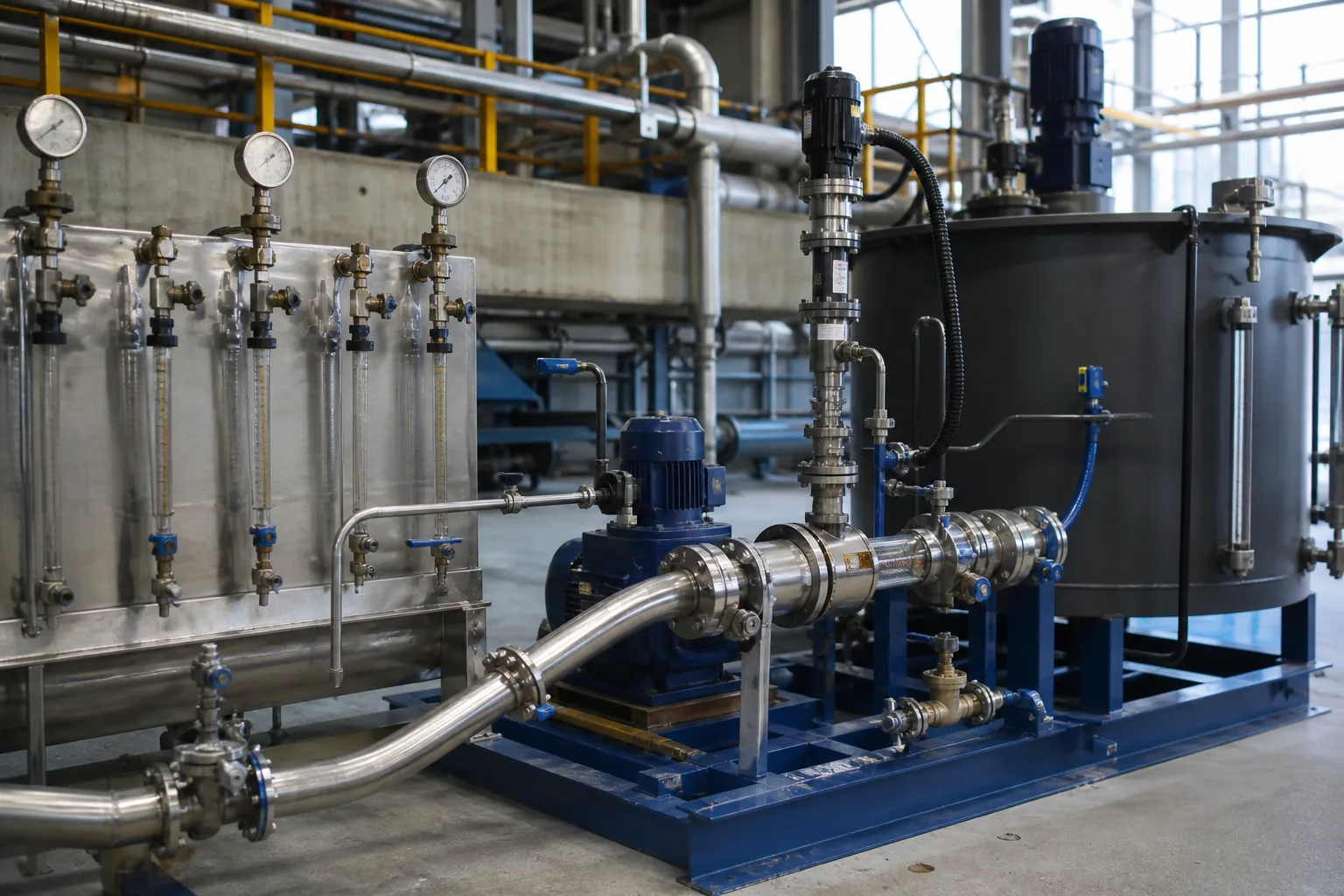
Compare complete treatment systems
Powder and inverse emulsion are delivery forms, not performance guarantees. Each can contain different charge and molecular profiles and requires appropriate preparation equipment.
Compare candidates only after both forms are prepared correctly and tested on the same feed and separator endpoint.
Review make-down equipment
Powder normally needs controlled wetting, dispersion and dissolution without fish-eyes. Emulsion requires metered water contact, inversion, dissolution and aging.
Map available water, floor area, automation, maintenance and operator tasks. The best form must fit reliable day-to-day preparation.
Normalize active dose
Delivered price per kilogram of product can mislead because active content differs. Convert consumption and price to active polymer, then relate it to dry solids and process outcomes.
Keep density and pump calibration in the emulsion calculation. Keep feeder calibration and powder loss in the dry calculation.
Assess storage and turnover
Review temperature, package size, shelf guidance, secondary containment and expected consumption. Long storage or poor turnover can change the practical risk for either form.
Match drums, IBCs or bags to unloading, lifting, transfer and inventory controls. Follow the product-specific SDS and supplier guidance.
Consider water and solution limits
Preparation water quality and temperature affect both forms, though failure modes differ. Emulsion inversion can be sensitive to hard or alkaline water and contact conditions.
Test the actual plant water and confirm the equipment can maintain the intended concentration across production rates.
Measure operational reliability
Track blocked lines, incomplete solution, cleanup, calibration drift, labor and unplanned interruptions during an extended comparison.
A form that wins a short jar test may lose commercial value if the plant cannot prepare it consistently.
Include supply and logistics
Compare package availability, lead time, freight mass, unloading constraints, emergency stock and waste packaging. Separate one-time equipment changes from recurring cost.
Request the same document and change-control expectations for both forms so supply risk is compared fairly.
Write a form-neutral award
Define feed, active dose, preparation, process endpoints and operating window before selecting form. Keep unsupported assumptions about faster or stronger products out of the specification.
The final choice should connect verified performance with plant handling and supply conditions, not rely on product form alone.
Compare safety and housekeeping
Review exposure routes, lifting, dust, slippery solution, spill containment and package waste under the current SDS for each candidate. Do not assume liquid automatically means lower overall handling risk.
Observe routine loading and cleanup during the pilot. Include training, protective equipment and time spent on spills or blocked preparation equipment in the practical comparison.
Build a life-cycle cost record
Separate chemical price, freight, package disposal, preparation water, energy, labor, maintenance, inventory and one-time equipment changes. Normalize recurring treatment cost to dry solids and accepted process output.
State which assumptions are measured and which are estimates. Test sensitivity to active dose, production rate and delivered price so a small uncertain input does not determine the award.
Run long enough to expose variability
A short trial may favor the form that is easiest to commission that day. Extend the comparison across normal feed changes, shift practices and enough make-down cycles to reveal reliability.
Repeat a known reference condition and preserve samples and logs. Select the form only after process performance and preparation consistency have both been demonstrated.