
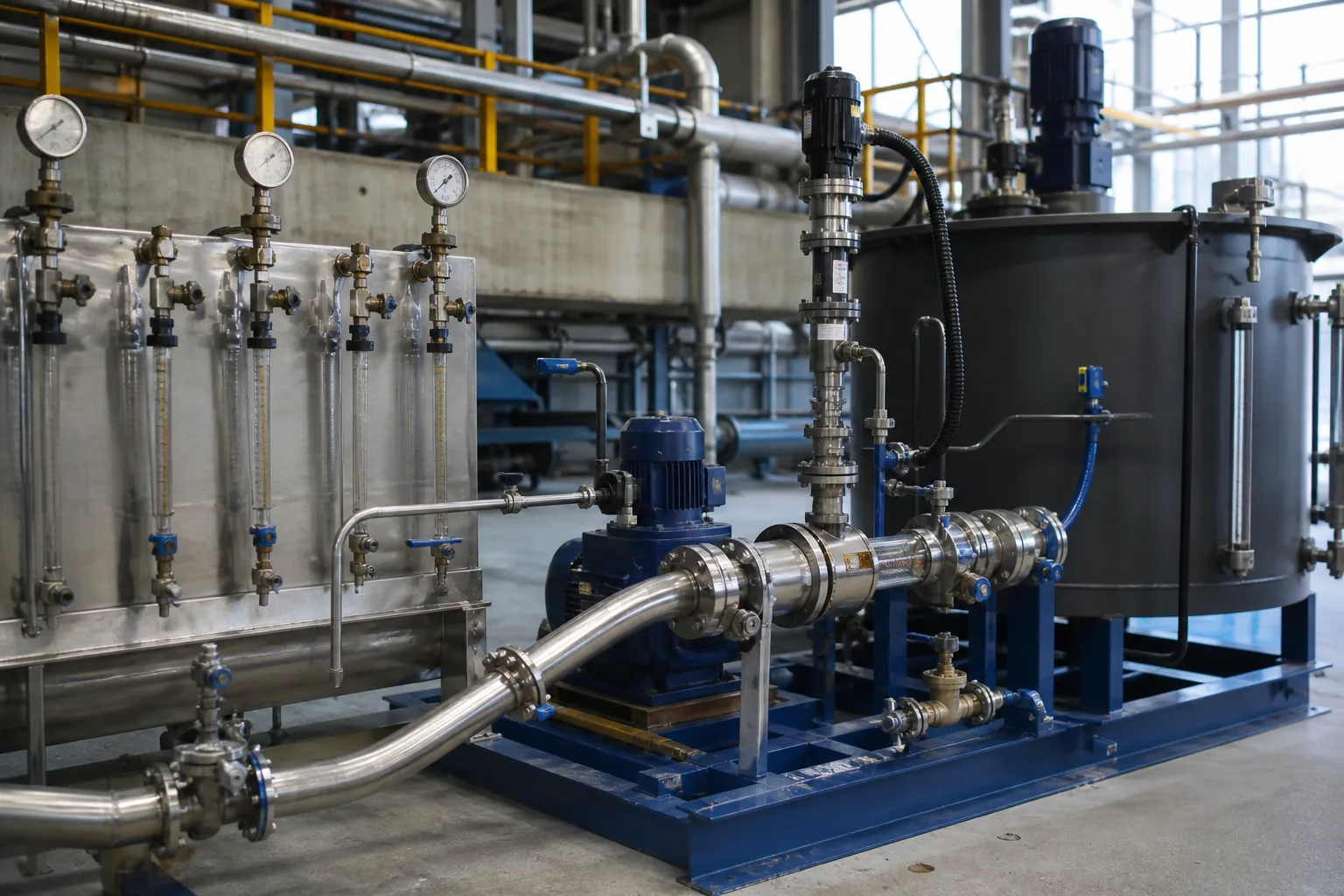
Map the liquid path
Trace neat emulsion from drum or IBC through transfer, day storage, calibrated pump, dilution-water contact, mixing, aging and injection. Confirm wetted materials and line condition.
A restriction, uncalibrated pump or recirculation path can alter delivered dose before chemistry is evaluated.
Inspect the neat product
Follow the supplier's storage and handling instructions. Record product temperature, visible separation, package age and any recommended gentle turnover before use.
Do not improvise aggressive recirculation. Excessive mechanical work can damage a product or create air and unstable metering.
Control water quality
Hardness, alkalinity, temperature and suspended solids can influence inversion and solution stability. Measure the actual make-down water rather than assuming plant water is constant.
If recycle or brackish water is proposed, compare it with suitable fresh water and document any change in dissolution or performance.
Create the contact condition
Meter emulsion into a moving water stream and provide strong initial dispersion at the contact point. Avoid adding a large water slug into neat emulsion or allowing concentrated gel pockets to form.
The objective is to separate emulsion droplets quickly, then allow polymer domains to hydrate without uncontrolled local concentration.
Set concentration and aging
Use the product-specific preparation range and size the aging volume for actual flow. A solution made too dilute at the contact point may invert poorly; an overly concentrated solution may be difficult to transfer.
Record water flow, neat flow, calculated concentration, temperature and residence time. Recheck them after every capacity change.
Protect the developed solution
Use transfer equipment and line velocities that deliver the solution consistently without unnecessary high shear. Avoid long stagnant lines and mixing changes that make solution age unpredictable.
Inspect for gel, deposits, phase-rich streaks or unstable flow. These observations help separate make-down faults from grade mismatch.
Calibrate active dose
Confirm neat-pump output by a measured drawdown or timed collection method suitable for the equipment. Convert it to active polymer using current product data.
Relate that mass to measured dry-solids feed. A correct pump percentage alone is not a portable dose basis.
Commission with process evidence
Start inside the successful bench window and adjust in small steps while recording settling, overflow, underflow and equipment response. Allow the system residence time to pass before judging a change.
Preserve the final water, concentration, aging and injection settings with the approved grade. They form part of the operating specification.
Plan cleaning and inspection
Create a routine for inspecting strainers, injection fittings, water nozzles, mixers, aging vessels and solution lines. Deposits or partially inverted gel can reduce flow and create unstable dose even when instruments appear normal.
Use cleaning materials and methods compatible with the equipment and product guidance. Prevent concentrated polymer or rinse water from reaching an uncontrolled drain, and document the condition found before maintenance changes it.
Manage shutdown and restart
Define how long neat emulsion and prepared solution may remain static under the supplier's guidance. Record the flush, isolation, gentle turnover or disposal steps required for planned and unplanned shutdowns.
On restart, verify water flow, pump calibration and solution appearance before reconnecting to the process. Do not treat yesterday's tank volume as newly prepared solution without checking its age and condition.
Build a fault-isolation sequence
If every grade appears weak, check make-down water, contact shear, neat flow, solution concentration and aging before widening the chemistry screen. If one grade alone changes, confirm sample identity and preparation history.
Link each symptom to a measurement: gel to inspection, low dose to calibration, poor inversion to water and contact, and process carryover to feed and separator conditions. This produces actionable troubleshooting instead of repeated dose increases.